Showing posts with label Hunter Tootoo. Show all posts

Saturday, 11 June 2016

DFO is the Problem With Salmon in BC - DFO Officials in Ottawa are the Problem

Citizens in BC have had serious issues with DFO in Ottawa on how it does not manage BC wild salmon properly for a very long time. The letters I have put on my www.onfishingdcreid.blogspot.com, all the way back to 1964 detail major misgivings BC has had with DFO (not staff in BC).

See: http://onfishingdcreid.blogspot.ca/2016/04/of-sport-fishers-now-and-then.html.

With the passing of the Harper government, BC has been happy to see the new Trudeau government signal more help for BC salmon. You will recall that BC has 99.8% of all the salmon in Canada, while half the country in the east, has only .2% of wild salmon.

Well, with Hunter Tootoo dealing with personal issues, and with BC still looking for the Cohen Commission findings to be acted on, including getting fish farms out of our pristine ocean, BC commentators are still having problems.

Watershed Watch put it this way, June 10, 2016 about meetings in April:

"But when we met with Minister Tootoo and senior DFO officials in Ottawa in April, it was clear that the same bureaucrats who ran DFO for the previous government were not in a hurry to follow their new orders. According to DFO, “acting on” Justice Cohen’s recommendations did not mean “implementing” them. Habitat provisions were not going to be returned to the Fisheries Act until extensive consultations took place (which could take years), and they were talking about rewriting the Wild Salmon Policy.

We were floored.
But not for long. We got to work organizing and lobbying to get Minister Tootoo and DFO back on track. We drafted this letter to Minister Tootoo that was endorsed by aboriginal, conservation, and fishing groups, and two former Fisheries Ministers, making it clear that we expect action on his to-do list."


So same old problem. As I have mentioned, I see that BC is starting to move in the direction of taking over salmon in BC from Ottawa.  

I would like you to know how many organizations and individuals, including two former DFO Ministers from BC, signed the group letter, sent May 18, 2016:


First Nations Wild Salmon
Alliance Union of BC Indian Chiefs
Pacific Streamkeepers Federation
BC Federation of Fly Fishers
BC Federation of Drift Fishers
The Honourable David Anderson, P.C., O.C., former Minister of Fisheries and Oceans, and former Minister of Environment
The Honourable John Fraser, P.C., O.C., O.B.C., C.D., Q.C., LL.D.(Hon.), and former Minister of Fisheries and Oceans
Watershed Watch Salmon Society
David Suzuki Foundation
Wild Salmon Forever
Raincoast Conservation Foundation
SkeenaWild Conservation Trust
Neskonlith Indian Band
Steelhead Society of BC
Kingfishers Rod and Gun Club
West Coast Environmental Law
Living Oceans Society
Squamish Lillooet Sportfish Advisory Committee
Sea to Sky Fisheries Roundtable
Squamish River Watershed Society
Vicky Husband, C.M., O.B.C.
Mark Angelo, C.M., O.B.C.
Dr. Patricia Gallaugher
Squamish Streamkeepers Society
Skeena Watershed Conservation Coalition
Georgia Strait Alliance
Clayoquot Action
Fraser Riverkeeper
Totem Flyfishers
Friends of Clayoquot Sound

The letter may be found here: http://www.actionforsalmon.ca/.

Here is a brief quote:

  1. “Act on recommendations of the Cohen Commission”. At a cost of $37 million, the Cohen Commission is the most comprehensive review of Pacific salmon management ever undertaken. We support Justice Cohen’s sensible recommendations and urge you to embrace their principles and fully implement the recommendations by the end of your current mandate.
  2. Fully implement all six strategies of Canada’s Policy for Conservation of Wild Pacific Salmon by the end of your mandate: (1) Standardized monitoring of wild salmon runs; (2) Assessment of habitat status; (3) Inclusion of ecosystem values and monitoring; (4) Integrated strategic planning; (5) Annual program delivery; and (6) Performance review. Brought in by the previous Liberal government in 2005, and neglected but left intact during the Harper years, the Wild Salmon Policy remains a foundational public policy with broad support from First Nations, fishing and conservation groups, and other British Columbians. Moreover, several of Justice Cohen’s recommendations focus on fully implementing the Policy as written. 
As above, the problem is bureaucrats in Ottawa. The Cohen tome has 21 recommendations about dealing with fish farms, and a direct recommendation for DFO to take them out of the water on Fraser sockeye migrations routes by 2020.

With Ottawa seen as the problem by BC residents, as above, I see the province moving toward taking over salmon in BC.

Please sign the petition to get fish farms out of BC's ocean and the Atlantic: https://petitions.parl.gc.ca/en/Petition/Details?Petition=e-270.

Here is another link to more information on what needs to be done by DFO in BC: http://fisheriesact.ca/?utm_source=Watershed+Watch+Email+List&utm_campaign=170a971e96-WW+news+update%3A+June+2016&utm_medium=email&utm_term=0_405944b1b5-170a971e96-214661381.



Monday, 30 May 2016

Fish Farm Workers First to get Fired - Updated June 3, 2016

Chile's algal bloom of March 2016 resulted in the loss of more than 125,000 mt of killed farmed salmon, some 25 million dead fish.

Fish farms always say they bring jobs to rural areas in need of employment, but twice in the past decade have laid off 13,000 to 26,000 workers in the ISA crisis in 2008, and now, less than a decade later, the algal bloom caused by an El Nino, fish farm sewage, and dumping of more than 75,000 mt of dead fish less than 50 miles off shore has brought the total of jobs lost this time to 10,000.

Fish farms are a boom bust industry and workers lose. Even in BC, Marine Harvest let 60 staff go just before Christmas a few years ago - and it won't take long for it to happen again, as owner, Fredriksen sold off $548 million MH shares recently, betting on a bust. Oh, and, Aarskog, CEO, wasn't laid off. MH lost 2.5 million fish in the algal bloom.

Currently, the 10,000 plus jobs lost are comprised of:

"According to estimates by Universidad Mayor economist Tomas Flores the total job losses are comprised of 5,000 small-scale fishers who have stopped work because of a ban on fishing, 4,000 aquaculture industry workers -- including salmon farmers -- and another 2,300 indirect jobs."

See:  https://www.undercurrentnews.com/2016/05/30/salmon-crisis-red-tide-to-double-unemployment-southern-chilean-region/?utm_source=Undercurrent+News+Alerts&utm_campaign=3e6b2843cf-Americas_briefing_May_30_2016&utm_medium=email&utm_term=0_feb55e2e23-3e6b2843cf-92426209.

The small-scale fishers job loss are a direct result of the fish farm fish/algal bloom. They carried out a 17-day strike in May that paralyzed farmed salmon shipments, including feed, to protest the ban on fishing that the government applied after officials discovered high levels of toxins in seafood caused by the red tide.


And now, Marine Harvest has laid off some more staff  in Chile:  http://www.intrafish.com/news/761871/marine-harvest-announces-layoffs-at-chilean-plant.

Because of salmon deaths, MH is laying off staff, about 145 in total. What this means is that in an industry in which disease kills, according to Professor Kibenge in PEI, one third to one half of its animals, workers are the front line pawns, sorry, that is harsh, as each individual situation is a personal tragedy, fish farm companies let them go. The alternative is on-land, closed containment and no one needs to get fired.

See: The Kibenge document: http://www.oie.int/eng/A_aquatic/Docs/Presentations/1.11Kibenge.ppt.


Friday, 27 May 2016

Boom Bust Industry - Marine Harvest Major Bust Soon


Market Analysis: Even Fredriksen, Marine Harvest Owner has/will sell Marine Harvest Shares.

See: http://seekingalpha.com/article/3975235-marine-harvest-sell-fredriksens-soon-expire-salmon.


"1. Marine Harvest, the bellwether of the global salmon farming industry, has successfully played an unsustainable dividend payout game to please its institutional owners and keep its share price up.

2. With a steep valuation after a multi-year rally, this stock is ripe for a correction. This article will argue why readers should be (short-)selling Marine Harvest at current levels.

3. Bulls are right in that salmon farming constitutes a promising source of food production for the future. The industry is supported by steadily growing demand and R&D improvements.

4. However, salmon farming is still farming. And farming means a commodity business where Mother Nature will offer challenges along the way, in the case of salmon: biological and environmental issues.

5. Major shareholder John “Viking Raider” Fredriksen and insiders cast their vote by cutting their holdings. Further operational problems or a cyclical salmon market downturn will eventually push this stock down."

So, even the owner of Marine Harvest, John Fredriksen has been and will be selling stock in his own company, to make money out of its Bust.

But there is more:

"Introduction: Highly correlated to a volatile salmon price

This article will discuss why the stock market valuation of Norway-based salmon farming giant Marine Harvest MHG is ripe for a major correction.

It all boils down to investor overconfidence in the robustness of MHG's line of business and associated cash flows. The stock promoters of MHG and the salmon farming sector continue to talk about further industry consolidation potential as a returns to scale play. Combined with a salmon price that has been on a tear of late even in strong USD terms (and more so in weak Norwegian kroner terms) MHG and the sector have risen to multi-year valuation peak levels. In USD terms, MHG's share price is up over 300 percent since last bottoming out 4.5 years ago in late 2011 (unadjusted for dividends).

If we let recent history serve as a probabilistic guide for what to expect from MHG and Norwegian salmon farming going forward we could just go back 10 years and compare the Norwegian salmon export price, in USD, with MHG's USD share price."

There is actually much more technical analysis on the coming crunch of Marine Harvest, but the point is that its share price is over valued, and has come to be closely tied to salmon prices - take a look at the graph comparing the two. The recent tear has come from Chile's disaster with algal blooms, killing 25 million farmed salmon, and ironically boosting prices, including MH that operates in Chile.

You will recall scientists saying an El Nino, fish farm sewage and dumping more than 75,000 metric tonnes of dead salmon at sea are the likely causes of the bloom and resultant kill off.

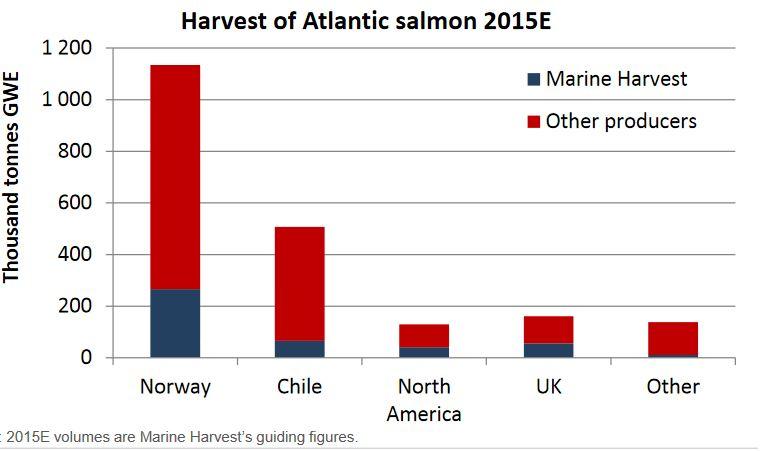
 Here are the harvest figures, Marine Harvest operating in: Belgium, Canada, Chile, France, the Faroes, Ireland, the Netherlands, Norway, Poland, Scotland and the U.S.


Because of its size, Marine Harvest dominates world Atlantic salmon harvests. But going forward, the long term growth of 6% per year, is going to slow to 3% until 2020, as in a very long time.

And there is this nagging problem of high dividends versus low cash flow and profit:

"MHG has chosen to keep its shareholders short-term happy by paying out too high dividends in relation to its operating profitability and cash flow."

And here is some of what Fredriksen owns:

"Apart from MHG, Fredriksen is currently a major shareholder in a number of U.S. listed shipping groups such as Golden Ocean (NASDAQ:GOGL), Frontline (NYSE:FRO) and Golar LNG (NASDAQ:GLNG) plus offshore drilling rig firm Seadrill (NYSE:SDRL) and supply vessel company Deep Sea Supply (OTCPK:DSSPF)."

This is important because Marine Harvest and the rest of the companies trot out the spin that they are here for local jobs in areas on hard times and revenue for countries. Not so, corporations exist only for shareholders. And Fredriksen is on a higher level, but a trader, so he will sell what will make him money, regardless of the problems for shareholders.

Because the oil sector Fredriksen owns has been in dire straits, that is why, in my News Bites post, you find he has sold out huge amounts of shares in his own Marine Harvest, from 26.07% to 17.67%, a third of his holdings. He sold at a high, 37.8 Million shares at 117 NOK or $548.1 Million USD.

News Bites post: http://fishfarmnews.blogspot.ca/2016/05/my-fish-farm-newsbites-post-that.html

In other words Fredriksen believes his own company is over priced and cashed out half a billion dollars of roughly 1.5B USD of his Marine Harvest holdings.

And others at Marine Harvest did the same (also in my News Bites post): "MHG chairman Ole-Eirik Lerøy cut his holdings by 1.1 million shares, or more than a third, to 2.1 million shares and MHG CEO Alf-Helge Aaarskog sold off 100,000 shares, corresponding to most of his shareholdings. Aaarskog now holds 38,570 shares and close to 1.7 million options in MHG."

And in Chile MH lost 2.5 million salmon, and laid off 500 workers. Hasta la Vista babies.

So, what do the authors of this analysis (it is as dense, tricky and cynical as you remember Michael Douglas in Anaconda, er, Wall Street) see in Marine Harvest's future? In their own words:

"Salmon farming leader Marine Harvest's current share price is supported by investors chasing a dividend yield of questionable sustainability while potentially underestimating the cyclicality and inherent risks of its commoditized fish farming business."

So, this just keeps on supporting the obvious: that fish farms are a Boom Bust Industry, and with Marine Harvest about to Bust, it's time to sell their shares, just like its owner, Fredriksen.

And don't buy back in until late 2016, to 2017. Just as I was thinking for my billions in shares. How about you?

And Norway itself is doing poorly because it is an oil exporting nation. The central bank has devalued the kroner 30%. This stimulates exports, including salmon, because the price is cheaper to purchasers. Norway unemployment is high, including 30,000 jobs lost in oil.

But the NOK devaluation can't last and when the price rises, all the farmed salmon sector companies will crash, not to mention oil. Shades of Alberta and Canada.

The technical analysis points out that 2016 - 2017 are bad for Marine Harvest shares. And long term salmon growth will halve to 3%, so its dividends (what shareholders really want) are unsustainable.


Fish Farm Diseases: First Nations May Demand Control over Wild and Farmed Salmon Testing

The fish farm disease hearings were initiated by Justice Cohen as a standalone session in his Commission into missing Fraser sockeye. He had concluded hearings but initiated a whole third section because he received evidence that made him conclude disease needed to be examined.

While many scientists had recorded ISA and other diseases, it was the Kibenge report that showed so wide spread ISA that he had to reopen the hearings. DFO submerged Cohen with several hundred thousand documents, but failed to include the Kibenge report with its damning evidence, belatedly, on the grounds all findings were false positives.

Cohen and the BC public didn't buy it. When his 1200 page tome came out the third section was largely about fish farm diseases and some 20 of the 75 recommendations were, too. The most important was that the government of Canada cancel the conflict of interest with fish farms that DFO has, and to just get on with saving wild Pacific salmon. He also said to move fish farms out of the water of salmon migration routes, particularly near Quadra Island.

Cohen:


“I therefore conclude that the potential harm posed to Fraser River sockeye from salmon farms is serious or irreversible. Disease transfer occurs between wild and farmed fish, and I am satisfied that salmon farms along the sockeye migration route have the potential to introduce exotic diseases and to exacerbate endemic diseases that could have a negative impact on Fraser River sockeye.” 

Justice Bruce Cohen


You will recall that DFO just recently, after the new Liberal government received 16,000 letters from BC voters calling for the appeal by Marine Harvest and DFO, to overturn the 2015 decicision banning fish farms from putting diseased fish in its fish farms, asked for an adjournment to study new evidence. See: http://www.leadnow.ca/wild-salmon/.

That evidence was that Dr. Kristi Miller has discovered PRV the presumed causative virus of HSMI, in a fish farm in Johnstone Strait. 

First Nations, fearing for their wild salmon resource, the major environmental factor in the proliferation of FNs in BC - one third of all FNs in all of Canada, may just declare it wants control over salmon. Here are the issues:


Potential Response
  1. First Nations demand emergency authority to oversee immediate sampling of farmed salmon for piscine reovirus throughout B.C. and require a bill of health for all farmed salmon before transfer into or through their territory.
  2. DFO must halt issuance of the long-term federal licences due to be granted to each farm beginning in the next few weeks, because piscine reovirus is so contagious.
  3. DFO must drop the appeal and not engage in reinstating the industry’s legal right to transfer diseased farmed salmon into ocean net pens.
  4. Assess whether the salmon farming industry in B.C. is capable of farming without contaminating regions around the pens with piscine reovirus and other pathogens and sea lice.

Potential Response
  1. First Nations demand emergency authority to oversee immediate sampling of farmed salmon for piscine reovirus throughout B.C. and require a bill of health for all farmed salmon before transfer into or through their territory.
  2. DFO must halt issuance of the long-term federal licences due to be granted to each farm beginning in the next few weeks, because piscine reovirus is so contagious.
  3. DFO must drop the appeal and not engage in reinstating the industry’s legal right to transfer diseased farmed salmon into ocean net pens.
  4. Assess whether the salmon farming industry in B.C. is capable of farming without contaminating regions around the pens with piscine reovirus and other pathogens and sea lice.

- See more at: http://alexandramorton.typepad.com/alexandra_morton/2016/05/briefing-significance-to-first-nations-dfo-announces-new-farmed-salmon-disease-may-23-2016-lawsuit-that-triggered-th.html#sthash.uhYPLulf.dpuf


“I therefore conclude that the potential harm posed to Fraser River sockeye from salmon farms is serious or irreversible. Disease transfer occurs between wild and farmed fish, and I am satisfied that salmon farms along the sockeye migration route have the potential to introduce exotic diseases and to exacerbate endemic diseases that could have a negative impact on Fraser River sockeye.”
Justice Bruce Cohen
- See more at: http://alexandramorton.typepad.com/alexandra_morton/2016/05/briefing-significance-to-first-nations-dfo-announces-new-farmed-salmon-disease-may-23-2016-lawsuit-that-triggered-th.html#sthash.uhYPLulf.dpuf
“I therefore conclude that the potential harm posed to Fraser River sockeye from salmon farms is serious or irreversible. Disease transfer occurs between wild and farmed fish, and I am satisfied that salmon farms along the sockeye migration route have the potential to introduce exotic diseases and to exacerbate endemic diseases that could have a negative impact on Fraser River sockeye.”
Justice Bruce Cohen
- See more at: http://alexandramorton.typepad.com/alexandra_morton/2016/05/briefing-significance-to-first-nations-dfo-announces-new-farmed-salmon-disease-may-23-2016-lawsuit-that-triggered-th.html#sthash.uhYPLulf.dpuf