Chile sustained a $2 billion loss in its fish farm industry when Norwegian fish farms brought ISA to Chile and after a number of years an epidemic broke out. The outbreak ended in 2010, and since, 23 sites have been sequenced for ISA again.
Typically, fish farms say that they can't have problems because the regulatory system in the country they are in is the most stringent in the world - they say this in Scotland, Norway and Canada at the moment - then when ISA breaks out, they want slaughter compensation and say the problem lay with the government and they may sue. They got $40 million from the feds for the NB ISA breakout; Norway has not gotten rid of ISA in 26 years.
The real loser here will be the Province of BC because it operates the disease testing regime. With five wild Pacific salmon of four of five species testing ISA positive in short order recently, it suggests there is something wrong with the provincial system - either its test or the reporting system - when they tested 4726 farm fish, with 1100 symptoms of ISA, but zero cases of ISA. At this point fish farms are still saying they have no ISA, but their strategy will unfold in the coming months, as more ISA is confirmed in wild Pacific salmon.
This link will take you to more than 50 articles on ISA: http://www.intrafish.com/search/?q=Chilean%20MP%20wants%20Norway%20ISA%20compensation&offset=30&sort=aged&useFromToDate=false.
Sunday, 6 November 2011

Thursday, 3 November 2011
Fish Farm Deaths - 29 Million Dead Fish
The BC Province's fish test tables show 29 million fish farm fish dead from all causes since 2003. Some deaths are legitimate such as 20K of smolts dying per fish farm plant on being put in saltwater.
Mary Ellen Willing, from fish farms, says fish deaths are about 1.5%. That comes out to about 10 million since 2003. That implies that the provincial percentage is 4.35% of fish farm fish die. Whether 10 million dead fish, or 29 million dead fish, a lot of fish are killed in in-ocean fish farming in BC.
The fish death figures from Norway are far higher: 16% in central Norway in 2009 (Trøndelag and Møre og Romsdal), or 10.6 million of 65.6 million.
The figure in 2008 for this area from disease was 22%, less than for Norway as a whole. This suggests that the BC deaths will increase dramatically over time for in-ocean fish farms.
This link is in Norwegian, but you can translate it at Google: http://www.nrk.no/nyheter/distrikt/nrk_trondelag/1.7859486?mid=51.
Friday, 28 October 2011
Closed, On-land Fish Farm Systems - Post being developed - Updated Dec 2, 2011
6.Read this report first: Technologies for Viable Salmon Aquaculture: http://www.saveoursalmon.ca/files/May_draft_05-04-10.pdf. This report clearly lays out the nuts and bolts of building on-land, closed aquaculture systems that make more money than in-ocean, open systems.
1. http://www.farmedanddangerous.org/wp-content/uploads/2011/01/ClosedSystemAqua-FINAL.pdf. Twenty Seven different systems. David Suzuki et al.
2.http://www.fishnewseu.com/latest-news/world/4742-canadian-report-assesses-economics-of-closed-containment.html.
3. http://www.dfo-mpo.gc.ca/aquaculture/lib-bib/nasapi-inpasa/BC-aquaculture-CB-eng.html. Prices systems
4. This is a 96 page abstract of aquaculture research in Canada - also the CIMTAN project. Excellent for giving you an overview: http://www.aquacultureassociation.ca/sites/default/files/2011%20RD%20Review%20%28English%29.pdf.
5. GAPI - index for evaluating aquaculture operations. John Volpi: http://lenfestocean.org/sites/default/files/gapi_report_pdf_version.pdf.
7. This is the technical papers on the Namgis First Nation on-land, closed, RAS system for raising salmon: http://www.namgis.bc.ca/CCP/Pages/default.aspx.

FISH FARM MYTHS - A Growing List - Updated Nov 21, 2011
1. Fish farms say they are producing fish to feed a hungry world. WRONG. They are producing fish for the first world countries that can afford to buy them. In 2004, the Canadian and Norwegian bare cost to produce a kg of farmed salmon was, respectively: $2.60 and $2.30. Then you add transportation per kg: Chile, for example, was $1.80, just to the US, and Norway is excluded from the US market due to high tariffs (26.7%).
Total cost per kg in CDN, NWY, CL: $4.25; $5.70; and, $3.75. The hungry countries of the third world cannot afford these prices.
Sales prices for 2011, 2012 and 2013 are expected to be depressed: To Come.
2. Fish farms need to be in the ocean. WRONG. I have a list of 33 mostly-closed, on-land, many recirulating systems. Just ask for it.
One facility is a research unit for 200 on-land systems. In the States there is a recirculating system, on-land association, and fish are grown on land around the world. Fish have been grown on land since the sixth century BC.
Norwegian derivative fish farms are old-tech systems that should have been retired long ago. The rest of the world has moved on to sustainable on-land facilities. This is the product retailers and consumers want now.
The Netherlands is 100% closed systems as their laws require that. So should other countries. See: http://www.fao.org/fishery/countrysector/naso_netherlands/en
And the CAAR site has very good, very current presentations on closed systems:http://tidescanada.org/salmon/aquaculture-innovation-workshops-and-reports/.
3. Fish farming on land costs too much to be competitive. WRONG. The best technical report on this subject, that details down to the nuts and bolts of on-land fish farms is this: Technologies for Viable Salmon Aquaculture: http://www.saveoursalmon.ca/files/May_draft_05-04-10.pdf.
4. Closed Container fish farms are uneconomical. WRONG Agrimarine, a closed, in-ocean system, is taking on Norwegian derivative fish farms in Norway. It is operating, also in China where no Norwegian derivative fish farm is allowed to set up shop: http://agrimarine.com/news/agrimarine-advances-with-r-d-concessions-in-norway.
5. Fish farms create a lot of employment. WRONG. In fact, after 26 years the BC industry has only 1,256 jobs - DFO figure - and MH just laid off 60 employees.The Netherlands has only 155. On the Isle of Eigge, Scotland, fish farms are trying to sell fish farms in this pristine area on the basis of 4 jobs. And, over time, employment drops because the feeding and lighting systems installed reduce the need for humans. In Nova Scotia, the initial labouring jobs let in 2010 were about $11 per hour. In BC, in comparison, forestry has 78,000 jobs. Fish farms are small employers and an even smaller percentage of GPP: 0.2% in BC.
Even in Norway, fish farming is small. Farms are densely packed and about 21 farms/BC farm. The claim is that 5,000 work in fish farming and the contribution to Norway's GDP is 0.5%. See this for further stats: http://topics.bloomberg.com/statistics-norway.
6. ISA gives false positive results frequently. WRONG. The provincial testing of 4,726 farmed salmon showed zero positives. In fact, it showed 1100 classic symptoms of ISA, but zero positives. If testing frequently gave false positives, fish farm fish would have given some positive tests for ISA.
On the other hand, the world designated expert lab under Dr. Kibenge, produced 5 positive results in about 60 wild fish tested for ISA - and in four of five species of Pacific salmon. This suggests that the provincial testing gave, if anything, false negatives.
7. We need more science rather than solving problems by putting fish farms on land. WRONG. Fish farms continue asking for science to avoid having to move. They still say, for instance, that sea lice don't transfer to and cause problems in wild salmon, after almost 30 years and 1000 lice per fish in Norway - where Slice no longer works. All that is needed is: DFO to focus on wild salmon and the precautionary principle.
8. We need more science. WRONG. Any reasonable person who Googles fish farm science will find science piled ten feet high saying that fish farms should be on-land, in closed containment.
9. Atlantic salmon is a wonderfully healthy, pristine product with huge amounts of Omega 3s and 6s. WRONG. The fat content of farmed salmon makes them contain high levels of polluting organic chemicals. 'While dioxin-like activity is found in almost all animal food products that contain fat, the levels in the farmed and market salmon that we have analyzed are higher than those in almost all other foods.'
10. You need Atlantic salmon because of its Omega 3s and 6s. WRONG. The diet of western people already contains excessive amounts of Omega 6s. And all the Omega 3s you need come from vegetable oils and animal fats.

Thursday, 27 October 2011
KEY LINKS - Fish Farm Share Prices and Financial Information, Updated May 31, 2012
Share price gives you an indication of what investors think about a company. The company's financial records give you an indication of the best picture the company can present of the company's health. (See bottom for Mar 2012 analysis)
Norwegian fish farm companies' share prices have been in freefall for some time: Marine Harvest is at: 44.2 cents; Cermaq is at $10.20; Grieg Seafood is at: 66.1 cents. All USA dollars.
Find Marine Harvest share prices:http://www.marineharvest.com/en/Investor1/Share-info/
Norwegian fish farm companies' share prices have been in freefall for some time: Marine Harvest is at: 44.2 cents; Cermaq is at $10.20; Grieg Seafood is at: 66.1 cents. All USA dollars.
Find Marine Harvest share prices:http://www.marineharvest.com/en/Investor1/Share-info/
Find Cermaq/Mainstream share prices:http://www.cermaq.com/portal/wps/wcm/connect/cermaqen/home/press/Share+information.
Find Grieg Seafood share prices:http://uk.finance.yahoo.com/q/hp?s=GSF.OL&a=5&b=21&c=2007&d=7&e=17&f=2011&g=d&z=66&y=0.
A quick analysis of the industry in October, 2011: http://biz.thestar.com.my/news/story.asp?file=/2011/10/25/business/9764783&sec=business. The selling price of 24 Kroner is $4.32 or negative income for Marine Harvest and Grieg Seafood.
This link says that the Norwegian derivative fish farms are all losing money: http://www.newsinenglish.no/2011/10/27/salmon-producers-face-new-crisis/
This link shows the bad financial position that Marine Harvest is in, 3rd Q income down 97%: http://www.bloomberg.com/news/2011-11-11/fredriksen-fish-farmer-chokes-on-salmon-glut-corporate-finance.html.
This is a currency converter: http://www.xe.com/ucc/convert/?Amount=1&From=NOK&To=CAD. Nov 27, 1 NOK = .1773 CDN Dollar. In other words: $1 CDN = 5.64 NOK.
See end of post for March 2012.
***
The financial reports make the companies sound in fine health. Investor's don't agree - shares are way down. Then go and follow brokers to the Oslo Stock Exchange. Their comments are frank and present a much more negative picture.
Marine Harvest 2010 Financial Report, delivered in 2011: http://marineharvest.com/en/Investor1/Press-releases/2011/2010-ANNUAL-REPORT-APPROVED---INCREASED-DIVIDEND-PROPOSAL-NOK-080-PER-SHARE/.
Cermaq 2010 Financial Report, delivered in 2011: http://www.report2010.cermaq.com/media/3681/0_cermaq_annual_report_2010.pdf. Do note that CEO Geir Isaksen has been moved from the government's Cermaq to the government's train transportation ministry.
Grieg Seafood 2010 Financial Report, delivered in 2011:
http://www.griegseafood.ca/financial_english.aspx?pageId=71. Click on the report image.
Bloomberg financial has frank comment on fish farms: http://www.bloomberg.com/news/2011-11-11/fredriksen-fish-farmer-chokes-on-salmon-glut-corporate-finance.html. This is the most cheery note in a couple of months. Look around for other articles.
Cermaq/Mainstream's 2011 Financial Report may be found here: http://hugin.info/134455/R/1602835/506955.pdf
Marine Harvest's 2011 Financial Report: http://www.marineharvest.com/en/Investor1/Press-releases/2012/Marine-Harvest-ASA-2011-Annual-Report/.
Here are stock price drops in Chile, Q1 2012: So far this year, several companies listed on the Santiago Stock Exchange have seen the price of their shares go down: 17.96 per cent overall. See: http://www.fis.com/fis/worldnews/worldnews.asp?monthyear=&day=31&id=52656&l=e&special=&ndb=1%20target=.
A quick analysis of the industry in October, 2011: http://biz.thestar.com.my/news/story.asp?file=/2011/10/25/business/9764783&sec=business. The selling price of 24 Kroner is $4.32 or negative income for Marine Harvest and Grieg Seafood.
This link says that the Norwegian derivative fish farms are all losing money: http://www.newsinenglish.no/2011/10/27/salmon-producers-face-new-crisis/
This link shows the bad financial position that Marine Harvest is in, 3rd Q income down 97%: http://www.bloomberg.com/news/2011-11-11/fredriksen-fish-farmer-chokes-on-salmon-glut-corporate-finance.html.
This is a currency converter: http://www.xe.com/ucc/convert/?Amount=1&From=NOK&To=CAD. Nov 27, 1 NOK = .1773 CDN Dollar. In other words: $1 CDN = 5.64 NOK.

See end of post for March 2012.
***
The financial reports make the companies sound in fine health. Investor's don't agree - shares are way down. Then go and follow brokers to the Oslo Stock Exchange. Their comments are frank and present a much more negative picture.
Marine Harvest 2010 Financial Report, delivered in 2011: http://marineharvest.com/en/Investor1/Press-releases/2011/2010-ANNUAL-REPORT-APPROVED---INCREASED-DIVIDEN
D-PROPOSAL-NOK-080-PER-SHARE/.Cermaq 2010 Financial Report, delivered in 2011: http://www.report2010.cermaq.com/media/3681/0_cermaq_annual_report_2010.pdf. Do note that CEO Geir Isaksen has been moved from the government's Cermaq to the government's train transportation ministry.
Grieg Seafood 2010 Financial Report, delivered in 2011:
http://www.griegseafood.ca/financial_english.aspx?pageId=71. Click on the report image.
Bloomberg financial has frank comment on fish farms: http://www.bloomberg.com/news/2011-11-11/fredriksen-fish-farmer-chokes-on-salmon-glut-corporate-finance.html. This is the most cheery note in a couple of months. Look around for other a
rticles.
All Oslo Fish Farm stock market prices can be found at: http://www.fishfarmingxpert.com/index.php?page_id=76&article_id=93626. Look in the right column.
2012 Financial News
Reuters analysis indicates that 2012 should be good. However, I think that Chile's production is so high and that the removal of the 26% tariff in the USA from Norwegian imports, and that Norwegian firms are after Scottish markets will produce a fish glut that will make prices fall, and be hard on Canadian production in BC, which has already laid off 60 people out of a maximum employment of 820 jobs: http://www.reuters.com/article/2012/03/08/salmon-norway-idUSL5E8E89Q220120308. BC sells 85% of its fish to the USA, hence problems with its own parent companies. Pretty ruthless.
Gobankingrates.com sees it much the same way as Reuters, noting Marine Harvest shares have climbed 34.7% since the beginning of the year. Go take a look and see that MH's share price almost disappeared in December 2011, at 37.4 cents/share. It's not hard to climb 34 percent from nothing and reach the gargantuan 56.1 cents/share on March 15, 2012
Cermaq/Mainstream's 2011 Financial Report may be found here: http://hugin.info/134455/R/1602835/506955.pdf
Marine Harvest's 2011 Financial Report: http://www.marineharvest.com/en/Investor1/Press-releases/2012/Marine-Harvest-ASA-2011-Annual-Report/.
Here are stock price drops in Chile, Q1 2012: So far this year, several companies listed on the Santiago Stock Exchange have seen the price of their shares go down: 17.96 per cent overall. See: http://www.fis.com/fis/worldnews/worldnews.asp?monthyear=&day=31&id=52656&l=e&special=&ndb=1%20target=.

Tuesday, 25 October 2011
KEY DOCUMENT - Fish Farm Tactics: Spinwatch.org, Updated Dec 22, 2018
The Norwegian derivative fish farms spun a communications strategy to render illegitimate a Science article from 2004 about the high level of dioxins, PCBs and other chemicals in Atlantic salmon farmed fish from Scotland.
You may find by the time you finish this investigative document on Spinwatch.org, that you no longer believe fish farm communications: https://www.academia.edu/2939514/Spinning_farmed_salmon.
This is the Science article that was neutalized: http://www.albany.edu/ihe/salmonstudy/salmon_study.pdf.
This report - see abstract - rates fish farms on the basis of their communications programs on sustainability and other issues:
http://www.seafoodintelligence.com/DesktopDefault.aspx?tabid=285.
Multinational fish farms are billion dollar companies that will adopt and change any strategy they think will move them forward.
This occurs at the same time as Marine Harvest is having difficulty making debt payments in Norway, its stocks trade lower than 48 cents, it has plead guilty to charges in BC of having caught wild fish in their nets and they have laid off more than 60 staff as they are having financial trouble..
Read the charges and other fines that Marine Harvest has had to pay. Follow the link through this site:http://www.salmonaresacred.org/blog/marine-harvest-court-canada-charged-illegal-possession-wild-fish
******
Update, Feb 16, 2017
Prof Ron Hites sent me a PDF on the work they did on the chemicals in salmon issue. He gives a class to his students each year. If you want a copy, send me a comment.
Here are some tables from the Science article:
The first image is:
"Concentrations (in ng/g wet weight, except dioxins) of 14 contaminants found in farm-raised (red bars) and wild (green bars) salmon. The vertical lines represent the 10th, 50th, and 90th percentiles, and the boxes represent the 25th to 75th percentiles. Dioxins are in pg of World Health Organization toxic equivalents (WHO-TEQs) per g of wet weight and include polychlorinated dibenzo-p-dioxins and dibenzofurans and dioxin-like PCBs. Typically 75% of the total TEQ was due to the dioxin-like PCBs. Other abbreviations are as follows: Tot DDT, the p,p′ and o,p′ isomers of DDT, DDD, and DDE; Nona, nonachlor; Chlor, chlordane; Hep Epox, heptachlor epoxide."
 Would you eat the fish from Scotland, the Faroes, Norway and the ones at the higher end?
I don't think so.
 These are the Science words: "Concentrations of (A) PCBs in ng/g wet weight, (B) dioxins (for detail, see Fig. 1) in pg of WHO-TEQ/g wet weight, (C) toxaphene in ng/g wet weight, and (D)
dieldrin in ng/g wet weight in farmed, supermarket, and wild salmon.
The concentrations are all given as functions of the locations where the
salmon were grown or purchased. Red represents farmed salmon, green
represents wild salmon, and yellow represents salmon purchased at
supermarkets. The error bars represent standard errors. The number of
samples is given in parentheses after the location identifier. The
locations are sequenced by average contaminant rank."
The reason the fish are full of chemicals because it is in their feed, meaning it originates from the global forage fish stocks that have been serially depleted by fish farms.
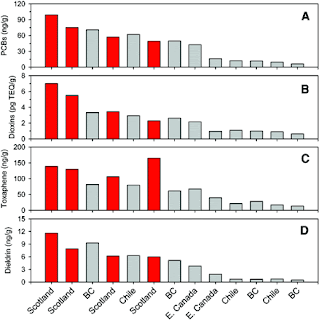 The feed text is: "Concentrations of (A) PCBs in ng/g wet weight, (B) dioxins (for detail, see Fig. 1) in pg of WHO-TEQ/g wet weight, (C) toxaphene in ng/g wet weight, and (D)
dieldrin in ng/g wet weight in commercial fish feed purchased at
facilities in various countries at various times of the year. Each bar
represents the analysis of one sample of fish feed, and the country from
which it was obtained is indicated. The concentrations are given as
functions of the locations where the fish feed was purchased. Fish feed
purchased in Europe is indicated by red, and fish feed purchased in
North or South America is indicated by gray. The locations are sequenced
by average contaminant rank."
And which fish would you eat? Answer: the green column ones. And they are the wild salmon. Who'd a thunk wild salmon would be better for you than farmed?
 The article text is: "Consumption advisories (in meals per month) based on U.S. EPA cumulative
risk assessment methods for PCBs, toxaphene, and dieldrin for (A) farmed (red) and wild (green) salmon and for (B)
supermarket salmon (yellow). The country in which the salmon was
produced or the city from which it was purchased is indicated."
Here is a short bio for Prof Ron Hites - many awards, long career, huge number of publications: http://www.hitesfest.indiana.edu/about.html.
*
Update Feb 26, 2018: Go read this post to find that the BC fish farms employed Hill and Knowlton, the same PR people who helped Big Tobacco sell its products and claim they did not know they caused cancer, several decades after everyone else in the world knew: https://fishfarmnews.blogspot.ca/2018/02/big-toobacco-big-fish-farms-pretty-much.html.
Update Dec 22, 2018: This 2018 article says that eating farmed salmon causes sterility in males and cancer. The article is from Norway/Morton: https://fishfarmnews.blogspot.com/2018/12/bad-news-bites-global-problems-in-fish.html. It is item 11.
Multinational fish farms are billion dollar companies that will adopt and change any strategy they think will move them forward.
This occurs at the same time as Marine Harvest is having difficulty making debt payments in Norway, its stocks trade lower than 48 cents, it has plead guilty to charges in BC of having caught wild fish in their nets and they have laid off more than 60 staff as they are having financial trouble..
Read the charges and other fines that Marine Harvest has had to pay. Follow the link through this site:http://www.salmonaresacred.org/blog/marine-harvest-court-canada-charged-illegal-possession-wild-fish
******
Update, Feb 16, 2017
Prof Ron Hites sent me a PDF on the work they did on the chemicals in salmon issue. He gives a class to his students each year. If you want a copy, send me a comment.
Here are some tables from the Science article:
The first image is:
"Concentrations (in ng/g wet weight, except dioxins) of 14 contaminants found in farm-raised (red bars) and wild (green bars) salmon. The vertical lines represent the 10th, 50th, and 90th percentiles, and the boxes represent the 25th to 75th percentiles. Dioxins are in pg of World Health Organization toxic equivalents (WHO-TEQs) per g of wet weight and include polychlorinated dibenzo-p-dioxins and dibenzofurans and dioxin-like PCBs. Typically 75% of the total TEQ was due to the dioxin-like PCBs. Other abbreviations are as follows: Tot DDT, the p,p′ and o,p′ isomers of DDT, DDD, and DDE; Nona, nonachlor; Chlor, chlordane; Hep Epox, heptachlor epoxide."
Would you eat these fish?
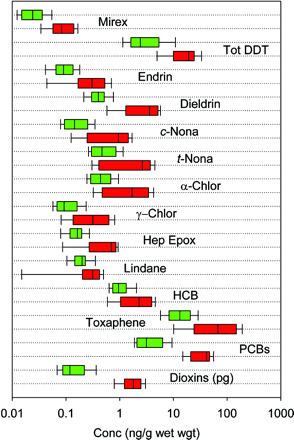
I don't think so.

The reason the fish are full of chemicals because it is in their feed, meaning it originates from the global forage fish stocks that have been serially depleted by fish farms.

And which fish would you eat? Answer: the green column ones. And they are the wild salmon. Who'd a thunk wild salmon would be better for you than farmed?

Here is a short bio for Prof Ron Hites - many awards, long career, huge number of publications: http://www.hitesfest.indiana.edu/about.html.
*
Update Feb 26, 2018: Go read this post to find that the BC fish farms employed Hill and Knowlton, the same PR people who helped Big Tobacco sell its products and claim they did not know they caused cancer, several decades after everyone else in the world knew: https://fishfarmnews.blogspot.ca/2018/02/big-toobacco-big-fish-farms-pretty-much.html.
Update Dec 22, 2018: This 2018 article says that eating farmed salmon causes sterility in males and cancer. The article is from Norway/Morton: https://fishfarmnews.blogspot.com/2018/12/bad-news-bites-global-problems-in-fish.html. It is item 11.
Saturday, 22 October 2011
KEY LINKS to Fish Farm News and Science - Updated Nov 26, 2011
This post will grow longer. It will list world wide press and scientific papers on fish farm issues.
A Current Review Article on ISA in Salmonids - Nov 26
Read this: http://www.cfsph.iastate.edu/Factsheets/pdfs/infectious_salmon_anemia.pdf.
A Good Example of Fish Farm Industry Spin - Nov 23
Read this: http://www.fis.com/fis/worldnews/worldnews.asp?l=e&country=0&special=aquaculture&monthyear=&day=&id=47741&ndb=1&df=0.
Marine Harvest says it will not expand in Chile for the next two years. But it is not saying that its financial problems are the cause. You can go look for yourself on share and financial report post on this site. See KEY LINKS in October 2011.
With shares at about 48 cents, investors don't think much of MH. There are links to brokers for up to date comment. Form your own opinion.
Good Review Article on the Phase after Fish Farms - Ocean Farming of Seaweed, Other Plants and Oysters - Nov 24
Read this: http://www.theatlantic.com/life/archive/2011/11/the-coming-green-wave-ocean-farming-to-fight-climate-change/248750/2/. This article acknowledges that fish harvesting and fish farming are sunset industries, but spends most of its length on developing where we will go for our food needs, fuel needs, take CO2 and nitrogen out of the sea, and produce oxygen at the same time.
Good Historical Article on Fish Farming in Scotland - Nov 23
See: http://forargyll.com/2011/11/scotlands-fish-farming-concept-to-reality/ This is a fair comment article on the history of fish farming in Scotland and how it has changed over the years. You should read it.
Fish Farms in Chile Facing Legal Case for Bringing and Spreading ISA, Nov 5
These two links outline the situation and cases launched in 2009: Link1.: http://www.fishfarmingxpert.com/index.php?page_id=76&article_id=85475.
Link 2.: http://www.latercera.com/contenido/655_161128_9.shtml. Link 2 is in Spanish, so run it through Google's translator program.
Cermaq and Marine Harvest research showed that the ISA was brought over by Aquagen, a company they own shares in. This links to an industry Powerpoint presentation:
http://www.cermaq.com/portal/wps/wcm/connect/0a6b9c8046d6bd2d81ddf38618b29640/Fiskehelse+b%C3%A6rekraft+270411+SVI+til+web.pdf?MOD=AJPERES
Cooke Aquaculture Charged for Using Illegal Chemicals, Nov 3, 2011
Environment Canada has charged Cooke Aquaculture of New Brunswick/Nova Scotia with use of illegal chemicals. The outcome could be as large as $33 million in fines and up to 99 years in jail for company executives for using cypermethrin to kill fish farm sea lice. It resulted in massive kills of lobsters as well. Read this article: http://www.southcoasttoday.ca/content/breaking-news-cooke-aquaculture-charged-environment-canada-illegal-pesticide-use.
Fish farms are also facing law suits in Chile for the disease disaster from 2008 to 2010: link to come.
Bruce Sandison - Cull of the Wild, The Daily Mail, Scotland, Oct 22, 2011
Scroll down this link about half way and then read the Bruce Sandison article on fish farms in Scotland. This is a restrained article that lists some of the problems in fish farms in Scotland. You will find these problems pretty much the same as in BC: http://www.superheroes4salmon.org/blogs/don.
Fish Farm Salmon Make Fat Diabetic Mice
This article says that mice fed with farmed Atlantic salmon high in fats (omega 3s, for instance) and persistent organic pollutants grew obese and developed diabetes: http://www.environmentalhealthnews.org/ehs/newscience/2011/10/2011-1018-pops-farmed-salmon-fatten-mice.
Fish Farm Marketing Report - Vancouver 2006: The Canadian Farmed Salmon
Industry -Benchmark Analysis for the US Market - Updated Nov 8, 2011.
This PDF study identifies how to best 'sell' in-ocean fish farms in Canada by identifying the advantages and disadvantages. Apparently, aboriginals need to be streamlined by the feds, and anyone who disagrees with fish farms is spreading 'falsehoods' among other things. And our ocean is pristine versus Norway's which is not, and NW's ocean is too cold. See the table on page four. The link is: http://www.ats.agr.gc.ca/can/4220-eng.pdf. The new link is: http://www.ats-sea.agr.gc.ca/can/4220-eng.htm.
Summary Stats: This is a good report to get to know fish farm financial and other statistical dimensions; however, it needs to be updated.
Cost per kg salmon: Exhibit 6, P 27. A well done table comparing CDN, NW and CHL.
Sites: Norway: 2400; BC: 130.
Concession Fee: Norway $800K; Canada: $0. An environmental assessment can be $75K - $150K in Canada
Annual Rent: NW: $0; BC: $3700 - 8900.
Canadian Mortality to Harvest: 5 - 15%. In comparison, in 2011, BC fish farms say: 1%.
Wage Rates: P 28.
Interview Comments: P 32, Exhibit 8.
Key Advantages and Disadvantages of Canadian industry in BC, P 34: No rules for aboriginals. ENGO falsehoods. If you disagree with fish farms you are making falsehoods. On the plus side BC has better access to USA market for whole gutted Atlantic Salmon.
Subscribe to:
Posts (Atom)