1. Ethoxyquin, the Slimy Inside Story: https://fishfarmnews.blogspot.com/2019/05/ethoxyquin-slimy-inside-story.html. Ethoxyquin is used to keep feed from blowing up. Yes, that is true, and also to prevent fats from going rancid. Check your dog food for E, and don't buy ones that use it.
2. MOST POPULAR POSTS, May 2019: https://fishfarmnews.blogspot.com/2019/06/most-popular-posts-may-2019.html.
3. PRV, DFO Doesn't Do Evidence and Science, Nor Precautionary Principle: https://fishfarmnews.blogspot.com/2019/06/prv-dfo-doesnt-do-evidence-and-science.html. This is a major post that shows DFO only uses science when it suits the narrative it is selling. And gives a link to some of the posts where this is discussed.
4. Fish Farms Kill Wild Salmon, Says Status of Wild Atlantic Salmon in Norway, 2018: https://fishfarmnews.blogspot.com/2019/04/fish-farms-kill-wild-salmonids-says.html. The next time a fish farm says there is no evidence it kills wild Pacific salmon, take this post and shove it in its face and say, "Nice try, turkey."
5. DFO Will/Won't Test for PRV: https://fishfarmnews.blogspot.com/2019/06/dfo-willwont-test-for-prv.html. This is the news release from the Pacific Salmon Foundation.
6. DFO's 2019 Fraser Chinook Plan: https://fishfarmnews.blogspot.com/2019/06/dfos-2019-fraser-chinook-plan.html. This lays out the DFO plan for sport fishing closures to save chinook that it hasn't conserved for 50 years and doing the same things it managed chinook into extinction over those years and won't adopt a new tactic.
7. Salmon Restoration and Innovation Fund: https://fishfarmnews.blogspot.com/2019/04/salmon-restoration-and-innovation-fund.html. The problems with the new fund for salmon habitat restoration. I have put in a suggestion and will let you know how it goes.
8. Robson Bight Orca Rubbing Stones: https://fishfarmnews.blogspot.com/2019/06/robson-bight-orca-rubbing-stones.html. My observations on logging and fish habitat, including the Tsitika River area which flows out into Robson Bight, Shcmidt Creek and Eve River.
9. Fish Farms Trap and Kill Wild Fish: https://fishfarmnews.blogspot.com/2019/06/fish-farms-trap-and-kill-wild-fish.html. 13 million in BC at any given time.
10. Daniel Pauly - Vanishing Fish: https://fishfarmnews.blogspot.com/2019/06/daniel-pauly-vanishing-fish.html. A new book by a Nobel Prize worthy scientist. My review.
11. Fish Farms Trap and Kill Wild Fish: https://fishfarmnews.blogspot.com/2019/06/fish-farms-trap-and-kill-wild-fish.html. In BC it is huge, amounting to 13.2 million at any given time.
Showing posts with label ethoxyquin. Show all posts
Showing posts with label ethoxyquin. Show all posts
Monday, 1 July 2019

Tuesday, 28 May 2019
Ethoxyquin, The Slimy Inside Story
Ethoxyquin used in fish feed is added to prevent the feed blowing up in transit, yes, explosions. It is also used to keep fats from going rancid. And there has been an on-going 'fight' for the past decade to get it out of food for humans, but it has been making our pets sick as it is used in pet food. See the Gloria Dodd letter at the bottom, who was a vet. Read it to see how many diseases are caused. And even for fish feed, which ends up in humans, the extension for getting rid of it is to 2020. Don't hold your breath that it will be taken out of our food stream, as the fish farm industry doesn't want that to happen.
Also see the Morgenbladet website: https://morgenbladet.no/aktuelt/2018/04/det-vi-ikke-vet-om-laksen.
"What we do not know about the salmon
Experts in double roles, disturbing animal studies and a researcher who stopped in the middle of an attempt. Here is the story of ethoxyquin, a synthetic substance in farmed salmon, which Norway defends, but the EU will ban."
Here is a Mercola article: https://articles.mercola.com/sites/articles/archive/2016/04/30/salmon-fish-farming.aspx.
"Overall, farmed salmon is five times more toxic than any other food product tested. In animal feeding studies, mice fed farmed salmon grew obese, with thick layers of fat around their internal organs. They also developed diabetes."

And: "The nutritional content is also wildly abnormal. Wild salmon contains about 5 to 7 percent fat, whereas the farmed variety can contain anywhere from 14.5 to 34 percent.
Many toxins accumulate most readily in fat, which means even when raised in similarly contaminated conditions, farmed salmon will contain far more toxins than wild.
Shockingly, research reveals that the most significant source of toxic exposure is not actually the pesticides or the antibiotics, but the dry pellet feed! Pollutants found in the fish feed include dioxins, PCBs, and a number of different drugs and chemicals."
The reason is that the fish used for feed are fatty fish, and thus concentrate things like dioxins, and ethoxyquin in the fat, which is then used for fish feed as Baltic states told their people not to eat the fatty fish.
And: "To the protein powder, they add an “antioxidant” called ethoxyquin. According to the filmmaker, this is one of the best kept secrets of the fish food industry. Ethoxyquin was developed by Monsanto in the 1950s — as a pesticide. Its use is strictly regulated, so why is it being added to fish pellets?"
And: " ...a Swiss anti-fraud laboratory was surprised to find extremely high levels of ethoxyquin in farmed fish — some 10 to 20 times higher than the 50 mcg per kilo allowed in food in the European Union — and that discovery began to unravel the secret. Ethoxyquin was designed for use on fruits and vegetables, but the fish feed industry discovered another novel use for it — they add it to the feed to prevent the fats from oxidizing and going rancid.
However, the fish feed manufacturers never informed health authorities of their use of the chemical. As a result, the EU strictly regulates ethoxyquin levels in fruits, vegetables, and meat — there are even standards for kangaroos and reptiles — but not for the fish people consume. What’s more, the effects of this chemical on human health have never been established."
And: here is a Bill Bryden link to ethoxyquin: https://www.facebook.com/groups/nlaquaculture/permalink/2406848442872334/.
"Ethoxyquin is required to be added to fish-meal in order to prevent it from exploding during sea transport and storage. The European Union has set an combined upper limit for ethoxyquin and other antioxidants (BHA and BHT) of 150 mg per kg of feed. Data obtained from fish-feed and feed-ingredient monitoring programmes have not revealed any instances of this limit being exceeded in Norwegian feed."
As above, the other reason for putting 'E' in fish feed is to keep the oils from going rancid. It was first developed as - you won't believe this - a pesticide.
From: https://nifes.hi.no/en/ethoxyquin-in-fish-feed/.
Feed producers can still use existing stocks of ethoxyquin during
the transitional period of a further three months. By the end of 2017,
the second step of this regulation* will enter into force, and all
companies involved in animal feed nutrition will have to discontinue the
use of this long-standing antioxidant ingredient."
Yes, but remember that 2020 date.
And, from 2013: https://www.hindawi.com/journals/ijfs/2013/585931/.
"Ethoxyquin (EQ, 6-ethoxy-1,2-dihydro-2,2,4-trimethylquinoline) is widely used in animal feed in order to protect it against lipid peroxidation. EQ cannot be used in any food for human consumption (except spices, e.g., chili), but it can pass from feed to farmed fish, poultry, and eggs, so human beings can be exposed to this antioxidant. The manufacturer Monsanto Company (USA) performed a series of tests on ethoxyquin which showed its safety. Nevertheless, some harmful effects in animals and people occupationally exposed to it were observed in 1980’s which resulted in the new studies undertaken to reevaluate its toxicity. Here, we present the characteristics of the compound and results of the research, concerning, for example, products of its metabolism and oxidation or searching for new antioxidants on the EQ backbone."
Suspension alarms fish farmers: https://www.intrafish.com/aquaculture/1327790/eu-ethoxyquin-suspension-alarms-fish-feed-producers.
And: https://www.bing.com/search?q=ethoxyquin+fda&FORM=QSRE8.
Says: Ethoxyquin was developed 35 years ago as a rubber stabilizer, has been used as a chemical preservative and is regulated by the FDA as a pesticide.
And: Ethoxyquin is a chemical preservative – and possible carcinogenic – regulated by the FDA (U.S. Food and Drug Administration) as a pesticide.
Here is an article for the general reader, May 2019: https://michaelkummer.com/health/diet/farmed-salmon/.
And here is that excellent letter, 1992, describing pet problems, including cancer and death from eating ethoxyquin over several decades, by Gloria Dodd, who is a retired veterinarian: https://truthaboutpetfood.com/ethoxyquin-carcinogenictoxic-food-preservative-in-pet-foods-a-letter-to-the-fda/. Do go read this one, as the effects on our pets are pretty bad.
Here is a Barentz Group slide presentation on antioxidants, including Ethoxyquin. This is highly scientific and for the specialist: https://www.fif.is/files/10/Antioxidants-Vitablend-Dvid-Prime.pdf.
It is worth a cruise.
***
These are the Siri Vike articles on ISA, not ethoxyquin, another issue fish farms and especially Aquagen didn't like: https://www.researchgate.net/profile/Siri_Vike.
Also see the Morgenbladet website: https://morgenbladet.no/aktuelt/2018/04/det-vi-ikke-vet-om-laksen.
"What we do not know about the salmon
Experts in double roles, disturbing animal studies and a researcher who stopped in the middle of an attempt. Here is the story of ethoxyquin, a synthetic substance in farmed salmon, which Norway defends, but the EU will ban."
Here is a Mercola article: https://articles.mercola.com/sites/articles/archive/2016/04/30/salmon-fish-farming.aspx.
"Overall, farmed salmon is five times more toxic than any other food product tested. In animal feeding studies, mice fed farmed salmon grew obese, with thick layers of fat around their internal organs. They also developed diabetes."
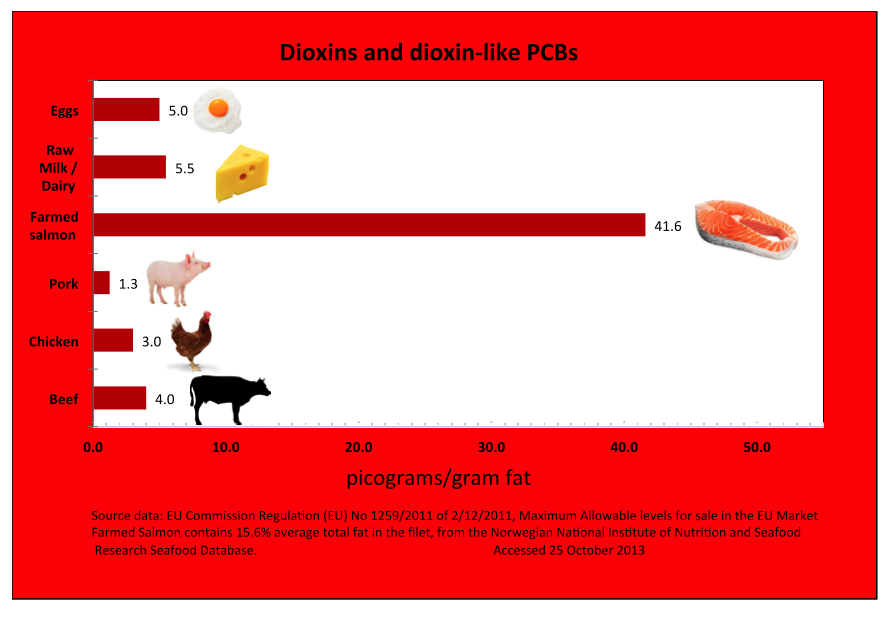
And: "The nutritional content is also wildly abnormal. Wild salmon contains about 5 to 7 percent fat, whereas the farmed variety can contain anywhere from 14.5 to 34 percent.
Many toxins accumulate most readily in fat, which means even when raised in similarly contaminated conditions, farmed salmon will contain far more toxins than wild.
Shockingly, research reveals that the most significant source of toxic exposure is not actually the pesticides or the antibiotics, but the dry pellet feed! Pollutants found in the fish feed include dioxins, PCBs, and a number of different drugs and chemicals."
The reason is that the fish used for feed are fatty fish, and thus concentrate things like dioxins, and ethoxyquin in the fat, which is then used for fish feed as Baltic states told their people not to eat the fatty fish.
And: "To the protein powder, they add an “antioxidant” called ethoxyquin. According to the filmmaker, this is one of the best kept secrets of the fish food industry. Ethoxyquin was developed by Monsanto in the 1950s — as a pesticide. Its use is strictly regulated, so why is it being added to fish pellets?"
And: " ...a Swiss anti-fraud laboratory was surprised to find extremely high levels of ethoxyquin in farmed fish — some 10 to 20 times higher than the 50 mcg per kilo allowed in food in the European Union — and that discovery began to unravel the secret. Ethoxyquin was designed for use on fruits and vegetables, but the fish feed industry discovered another novel use for it — they add it to the feed to prevent the fats from oxidizing and going rancid.
However, the fish feed manufacturers never informed health authorities of their use of the chemical. As a result, the EU strictly regulates ethoxyquin levels in fruits, vegetables, and meat — there are even standards for kangaroos and reptiles — but not for the fish people consume. What’s more, the effects of this chemical on human health have never been established."
And: here is a Bill Bryden link to ethoxyquin: https://www.facebook.com/groups/nlaquaculture/permalink/2406848442872334/.
"Ethoxyquin is required to be added to fish-meal in order to prevent it from exploding during sea transport and storage. The European Union has set an combined upper limit for ethoxyquin and other antioxidants (BHA and BHT) of 150 mg per kg of feed. Data obtained from fish-feed and feed-ingredient monitoring programmes have not revealed any instances of this limit being exceeded in Norwegian feed."
As above, the other reason for putting 'E' in fish feed is to keep the oils from going rancid. It was first developed as - you won't believe this - a pesticide.
From: https://nifes.hi.no/en/ethoxyquin-in-fish-feed/.
Ethoxyquin does not belong in your food: https://www.nutraceuticalbusinessreview.com/technical/article_page/Ethoxyquin_does_not_belong_in_your_food/99579.
And: https://www.allaboutfeed.net/Feed-Additives/Partner/2017/10/Ethoxyquin-use-in-animal-feed-suspended-198110E/. Says, of the EU decision to suspend EQ:
"Antioxidant manufacturers and
suppliers can no longer market formulations for animal feed which
contain ethoxyquin, as of 28th September 2017. This action represents
the first step in the suspension of ethoxyquin use in animal feeds.
Yes, but remember that 2020 date.
And, from 2013: https://www.hindawi.com/journals/ijfs/2013/585931/.
"Ethoxyquin (EQ, 6-ethoxy-1,2-dihydro-2,2,4-trimethylquinoline) is widely used in animal feed in order to protect it against lipid peroxidation. EQ cannot be used in any food for human consumption (except spices, e.g., chili), but it can pass from feed to farmed fish, poultry, and eggs, so human beings can be exposed to this antioxidant. The manufacturer Monsanto Company (USA) performed a series of tests on ethoxyquin which showed its safety. Nevertheless, some harmful effects in animals and people occupationally exposed to it were observed in 1980’s which resulted in the new studies undertaken to reevaluate its toxicity. Here, we present the characteristics of the compound and results of the research, concerning, for example, products of its metabolism and oxidation or searching for new antioxidants on the EQ backbone."
Suspension alarms fish farmers: https://www.intrafish.com/aquaculture/1327790/eu-ethoxyquin-suspension-alarms-fish-feed-producers.
And: https://www.bing.com/search?q=ethoxyquin+fda&FORM=QSRE8.
Says: Ethoxyquin was developed 35 years ago as a rubber stabilizer, has been used as a chemical preservative and is regulated by the FDA as a pesticide.
And: Ethoxyquin is a chemical preservative – and possible carcinogenic – regulated by the FDA (U.S. Food and Drug Administration) as a pesticide.
Food additive amounts: https://www.fda.gov/AnimalVeterinary/Products/AnimalFoodFeeds/IngredientsAdditives/ucm541035.htm.
And another that mentions E keeps feed from exploding: https://www.nutraceuticalbusinessreview.com/technical/article_page/Ethoxyquin_does_not_belong_in_your_food/99579. And has a good list of the standards in different counttries, and a list of references at the end.
And even Wikipedia has an article on 'E': https://en.wikipedia.org/wiki/Ethoxyquin. It was invented by Monsanto in the 1950s, as a pesticide. It has been used to keep fats from going rancid in pet food, aquaculture feed and so on. It should not be found in human food, like, wait for it, farmed fish.Here is an article for the general reader, May 2019: https://michaelkummer.com/health/diet/farmed-salmon/.
And here is that excellent letter, 1992, describing pet problems, including cancer and death from eating ethoxyquin over several decades, by Gloria Dodd, who is a retired veterinarian: https://truthaboutpetfood.com/ethoxyquin-carcinogenictoxic-food-preservative-in-pet-foods-a-letter-to-the-fda/. Do go read this one, as the effects on our pets are pretty bad.
Here is a Barentz Group slide presentation on antioxidants, including Ethoxyquin. This is highly scientific and for the specialist: https://www.fif.is/files/10/Antioxidants-Vitablend-Dvid-Prime.pdf.
It is worth a cruise.
***
These are the Siri Vike articles on ISA, not ethoxyquin, another issue fish farms and especially Aquagen didn't like: https://www.researchgate.net/profile/Siri_Vike.
Subscribe to:
Comments (Atom)